

Imagine a precocious, driven, and empathetic undergraduate student. She has discovered a passion and a talent for biochemistry, and wants to apply to graduate school to pursue agronomy, with the goal of returning to her rural community home after graduation. She loves science and nature; she is also a committed Christian. She has a vague sense that these things are connected, but she isn’t sure how. And to be honest, the people around her in college do not always believe these two parts of her identity are compatible. Nevertheless, she plans to pursue graduate studies and hopes her faith will not be negatively affected.
Now, imagine the various types of academic conversations she is likely to encounter in her years of graduate school. Much will depend, of course, on her course of study and the interests and capabilities of her professors, colleagues, and peers. Like many graduate students before her, she is likely to find herself navigating a broad array of sometimes conflicting narratives and perspectives. She may be wondering how to chart a course through it all while remaining true to her beliefs and worldview.
The experiences of this hypothetical student are far from unique: in fact, many elements of her journey are reflected in our own professional and spiritual lives.[1] In seeking to navigate these challenges, we identified a deep and overarching need to better investigate the following questions: how should Christian scholars in the agricultural sciences think about the relationships between their Christian convictions and worldviews and their work as scientists, scholars, educators, and, frequently, entrepreneurs and consultants? What are the various institutional influences, disciplinary avenues, and cultural assumptions that form and shape Christian scholars’ approaches to this question over time? In this piece, we hope to explore these questions and contribute meaningfully to the professional and spiritual growth of other scholars in the field of agriculture.
While agriculture is amongst the oldest of human endeavors, massive technological and cultural changes over the last two centuries have dramatically changed both the physical and metaphorical landscape. In the Western world, agricultural enterprises have become more industrialized and are increasingly owned by non-resident entities like family farm trust boards or corporations.[2] These changes in scale and stakeholders have exacerbated old tensions and created new ones between the flourishing of people who work in agriculture and those who eat and wear its products, the flourishing of agricultural-based communities, and the flourishing of sustainable landscapes and the broader environment. These tensions related to profit, environmental stability, and the common good create what, at times, appear as thorny and intractable brambles, with no real solution.[3]
As Christians, we are not called to inaction or apathy when faced with such challenges, but, like Adam, to till and work the fields despite these thorns (Genesis 2:15; 3:18, 23).[4] Our hope and goal should be the ideal of Shalom: the peace and flourishing that is embedded in the biblical narrative and Christian beliefs, and contains a special connection to agriculture. In the field of agriculture, therefore, we believe that Christians have a particular calling to be “salt of the earth” and “light[s] of the world” (Matthew 5:13–14) beyond even the general call to faithful witness placed on Christians in all fields.
Articulating the implications of the Christian moral and theological tradition will help illustrate how this faith community can navigate the dominant cultural logics at play in the agricultural sphere.[5] The term “cultural logics” will be further developed and defined below, but broadly speaking, these logics encapsulate sets of assumptions and value hierarchies that make up particular “ways of thinking” in a given field. As we situate Christianity within the scope of contemporary American agricultural thought and practice, we highlight the need to examine Christian approaches to agriculture. In limiting our scope to a contemporary American approach to agriculture, we seek to focus on the context to which we can speak most authoritatively—all authors are or have been associated with a university which teaches agriculture as part of its mission as a Land Grant institution, founded under the Morrill Act of 1862. A full history of the Land Grant system is beyond the scope of this paper, but the particular 19th century view of scientific agriculture which lead to its creation, and the various schools of thought which have grown in response to that particular framing of agriculture, have irrevocably influenced the practice of agriculture in the United States, industrialized nations, and by extension, the whole world.[6] A theological lens should play a role in shaping how Christian agricultural practitioners think about, interact, engage, promote, and encourage practices at all stages of agriculture, from production to consumption, to glorify God, love our neighbors, and steward creation. One of the important places where this can occur is in the shaping of the next generation of agricultural leaders during their university education.
Our argument will be developed as follows: first, we outline and define some of the dominant cultural logics that frame approaches and attitudes towards agriculture, focusing on those likely to be encountered at a secular university. Next, we identify some of the assumptions and values that underlie these logics, as well as areas where they converge or diverge from a broadly Christian worldview. This requires an explanation of the major Christian teachings that we believe have agricultural relevance. We aim to show how Christianity provides (a) boundaries of practice and (b) orderings of ends that can inform all agricultural-related activities, be they in the kitchen, field, pasture, feedlot, laboratory, classroom, farmer’s market, supermarket, or boardroom. Next, we will discuss the relevance of our framework for a particular test case: our relationship to ecological limits as it relates to agricultural policy and practice. Our test case is provided so that Christians in agriculture can reflect on their own actions and responses to these scenarios as preparation for future encounters that may challenge them to deviate from their convictions. Finally, we conclude with a discussion about possible implications specific to Christian professors, particularly those in agricultural sciences.
This attempt to discern faithful Christian approaches to agriculture derives from a conviction that the plan and will of God permeate all creation and human endeavors. We do not aim to deliver a comprehensive or authoritative account of how Christians should respond to specific pressing dilemmas in agriculture, nor do we attempt to define the limits within which we should restrain ourselves or our agricultural practices. Instead, we provide this discourse because we believe that several reasonable conclusions may be drawn within the bounds of a Christian understanding of the world.
Cultural Logics and Agriculture
When faced with a decision or constraint, individuals draw on a range of experiences, knowledge, and values to appropriately evaluate the costs and benefits. Typically, people undertaking this process are not simply reliant on their own resources; they also draw on a socially-derived framework or set of principles known as a “cultural logic” in order to analyze potential outcomes and, therefore, create a hierarchy of values.[7] These logics may be thought of as a set of assumptions,[8] which are either held explicitly and consciously as a moral or ethical code, or implicitly and unconsciously understood as “the way the world works.” In other words, examining held cultural logics requires asking oneself, among other questions, “why do I think certain things are more important than others?” These principles or assumptions may be molded by cultural practices, education, spiritual experience, and so forth.[9] Cultural logics may be best understood as “ideal types” or “caricatures” that bring to light certain recognizable features or tendencies of individuals and groups.[10] In our framing, cultural logics differ from worldviews in that worldviews are comprehensive and explicitly held systems (such as faith traditions or philosophical systems), whereas cultural logics are more constrained to a particular sphere of practice or activity and are limited specifically to hierarchies of values.
Because cultural logics are often held unconsciously, and can be molded by any number of sources, we contend that a key problem facing Christians in agriculture (and any number of other fields) is the uncritical absorption of cultural logics that are primarily secular, and which may hold assumptions that run counter to a Christian understanding of reality. If the reader takes only one actionable item from this paper, we hope that it is a newfound awareness of and desire to examine the assumptions and value hierarchies that underlie their personal decision-making. Below, we focus on four cultural logics that are embedded, to varying degrees, in the practice of agriculture: industrialism, ecocentrism, agrarianism, and technological utopianism.
In our experience, all four of these cultural logics are frequently encountered and examined in some form through the course of university classes and research. By explicitly naming dominant cultural logics and their underlying assumptions, we hope to better equip educators and students to critically evaluate these ways of thinking. In examining these logics, we seek to draw on the work of authors who display characteristics associated with the logic. However, at times we have found it appropriate to lean on our own lived experiences in the space of university agricultural education, given the relative dearth of literature examining cultural logics in this community. We strive to make clear when claims about the four cultural logics primarily derive from our experiences, and we encourage the reader to critically evaluate our claims.
Underlying these four logics are two dichotomies. The first is a disposition towards change, with a preservationist rejection of change at one extreme, and a revolutionary desire for constant change at the other. The other dichotomy is a disposition towards the scope of concern for decisions—narrow and/or immediate versus broad and/or long-term. Broadly speaking, agrarianism and ecocentrism tend towards preservation, and industrialism and technological utopianism tend towards change. Meanwhile, agrarianism and industrialism tend towards a narrow or specific scope, while ecocentrism and technological utopianism tend towards a broad scope. Few would desire to take either of these dichotomies to the extreme; for example, most people with a preservationist disposition would agree that change is sometimes necessary, and so on. However, in our framework, each cultural logic is best understood by thinking through the implications of the extreme corners of the quadrant formed by the two dichotomies as the “purest” form of the logic.
Here, we strive, to the extent possible, to “de-personalize” the cultural logics we have selected for examination, preferring to discuss certain ideas or priorities as being consistent with the framework of the cultural logic, rather than specifically aligning writers or thinkers with one of the logics at the exclusion of the others. In other words, we prefer to discuss ideas consistent with the logic of “industrialism” rather than identifying specific thinkers as “Industrialists.” Our reason for this is two-fold. First, we believe that a key aspect of a cultural logic is its largely unconscious nature—this is one of the main features that distinguish a logic from a consciously-held, comprehensive worldview. Thus, many individuals who would espouse ideas or priorities associated with a given logic may not identify themselves with said logic. This is not universally true, of course, and many thinkers do explicitly align themselves with one of the four logics we will examine. Many of these individuals are quoted in the section describing the relevant cultural logic. However, because our goal is to apply these logics to assist in sorting out the complex and often conflicting sets of values, assumptions, and priorities held by students and practitioners of agriculture (or any other applied field), we find focusing on the abstract, consistent logic more rhetorically useful. Our second reason is related to the last point above: people are complex and complicated, and few public intellectuals cleanly and unambiguously fit only one of our four logics. Thus, it is more helpful to extract and discuss specific ideas that fit each of the four logics.
Industrialism
Industrialism sees productivity and profit-making for owners as the primary goal of agriculture. Those defined by this system of thinking see the food, fuel, and fiber produced by agriculture as commodities with a market-dictated cash value; crucially, the actual end use of the product (as nourishment, energy, clothing, etc.) is of secondary importance. In other words, the specific crop or product produced is better thought of as a means to profit, creating income for the producer and potentially financial returns for shareholders.[11] Often, wealth is accumulated in the form of money and land to pass on to the next generation, thus keeping farms within individual families for multiple generations.[12] Industrialism sees financial return as the primary good worth pursuing, placing a lower priority on considerations such as technical, environmental, or social limits. This means, as former Secretary of Agriculture Earl Butz famously quipped, farms, in countries with capitalist economies, should “get big or get out.” [13] Since the end of World War II, this concept (even before being put into pithy terms by Butz) has been taken seriously by United States farmers, either as advice for successful farming or as a way to describe the economic landscape. Average farm size has continued to increase yet the number of farms in the United States and the amount of land in farms continues to decline.[14]
Another key feature of Industrialism, in our observation, is its anthropocentrism: the needs and wants of humans are placed at the very center of consideration, largely to the exclusion of other concerns. Humans are viewed as consumers, sources of labor, and potential competitors. Non-human life represents something that can be used to create wealth and is less often seen as having intrinsic value.[15] Land, water, and energy are directed toward maximum agricultural production, with little emphasis on long-term sustainability of natural systems. Key to the industrialist mindset is the concept of “externalities,” whereby damages both to natural systems and to human communities are typically considered to be beyond the producer’s scope of concern and are therefore not accounted for in the market price of the product.[16] Industrialism does not see human economic endeavors as embedded within and dependent upon natural ecosystems; rather it sees economic activity as being apart from and above such systems. Recent efforts have even attempted to place a monetary value on ecosystem services provided by agricultural systems,[17] an attempt to increase the priority of these concerns within an industrial logic. This development perhaps highlights a key characteristic of industrialism: rather than being inherently hostile to natural systems, negative interactions are more likely to result from a lack of consideration, or “blind spot” towards them, stemming from the key industrialist principle of prioritization of profit through production.
Ecocentrism
Ecocentrism is a conceptual framework that emphasizes a nature-centered system of values, with no hierarchy of lifeforms. Man is one among many forms of life, and the growth and well-being of human societies is not prioritized over the health of natural systems—a concept termed “biospherical egalitarianism.”[18] As a consequence of this framing, those working within an ecocentric logic often recommend minimizing the impact of the human population upon the earth,[19] with the end goal of maximizing ecosystem integrity and preserving the natural environment. Some have proposed keeping half the earth human-free for the sake of biodiversity[20] yet others argue that indigenous people in the world’s most threatened ecosystems have been contributing to the elevation of biodiversity through their domesticating nature as part of their daily activities to provide food, clothing, and shelter for their families and community.[21]
In this framework, agriculture is often viewed as competitive with natural landscapes and natural processes occurring within the landscapes.[22] This creates an inherent tension with agriculture; farming, as generally practiced, requires changes to natural landscapes, soils and water, and microbial, insect, plant, and animal populations. In many cases, these changes over the centuries have caused agriculture to degrade ecosystems from their original functions and integrity. [23] It has been argued that prehistoric agriculture, which transformed the forests and wetlands since its emergence, altered earth’s atmospheric chemistry substantially enough to mark the onset of the Anthropocene,[24] a geological epoch that has been proposed to mark the global environment deeply affected by the humanity.[25] Identifying ways to minimize or eliminate this degradation at local to global scales is a key ecocentric concern in agriculture.
The ways in which ecocentrism would address these concerns are diverse. Ecocentrism, as we have defined it, generally accepts that meeting human needs is vital to any practicable cultural logic, and this will require some destruction of natural systems.[26] This recognition, juxtaposed with the aforementioned concept of biospherical egalitarianism, inherently creates tension—as the logical conclusion of true egalitarianism would not prioritize human needs over those of any other creature or natural system. Generally, ecocentrism finds its place in wider cultural conversation through preservation and the pursuit of sustainability—frameworks where both humans and nature can continue to co-exist and thrive into the future.
In the sustainability framework, human activities, including agriculture, are conducted such that there is minimal overall negative impact on the natural world.[27] However, true ecocentrism diverges from mainstream environmentalism in its assessment of the relative value and rights of humans, non-human organisms, and natural ecosystems. Many individuals within a broader environmentalist perspective or movement adopt the anthropocentric concern that the preservation of natural ecosystems and their non-human inhabitants is either necessary or advantageous for humans in the long term. In contrast, strict ecocentrists adhere to the belief that these ecosystems and their inhabitants possess inherent value and the right to exist and function, irrespective of human benefits. Nonetheless, ecocentrism’s stance is somewhat compromised, as unspoiled wilderness with minimal to no human impact is essentially nonexistent. The deep rainforests of the Amazonian region, for instance, have undergone management practices for thousands of years that favor the proliferation of tree species of commercial value to humanity.[28]
Agrarianism
Agrarianism is centered on the flourishing of human communities, typically prioritizing rural or agricultural communities. In the agrarian logic, flourishing may be considered akin to healthiness. In a true state of flourishing, not only are all the material needs of an individual, family or community met, but there is also an overarching sense of “wholeness” or “wellness.”[29] Wholeness is derived from the right participation of and relationship between members. For individuals, this sense of wholeness can only be achieved through relationships with the broader community; and for communities, wholeness is derived from the right participation of and relationship between members. In the agrarian logic, an agricultural enterprise is viewed first as providing sustenance for families, and by extension, for communities. Conducting the work of agriculture in the “right” way should not only provide adequate sustenance but also contribute to the wellness of the individual and the community. Profit and growth are not seen as inherently good but rather are viewed positively only when serving the end of sustenance. Limits, imposed both by cultural systems and natural systems, are seen as vital for maintaining the health of communities.
The extent to which the health of natural systems is seen as an inherent good varies. For some agrarians, natural systems are primarily considered as the substrate in which cultural practices develop and by which they are shaped[30] and so stewardship of these systems as coherent entities is not necessarily prioritized. For others, like ecologist Aldo Leopold, the health of natural systems is vital. As Leopold once wrote in developing a “land ethic,” “a thing is right when it tends to preserve the integrity, stability, and beauty of the biotic community. It is wrong when it tends otherwise.” [31]
Associated with the previous point, variation on the “community” prioritized by this cultural logic is a source of diversity. At one extreme, an agrarian logic may focus almost exclusively on a family unit.[32] The community of concern for others may spread more broadly to a geographically defined area (town, region, state, nation), or, at the opposite extreme, a holistic vision of a global community. In our anecdotal experience, a focus somewhere between family and a constrained region is the most common community of focus, but this is by no means universal. Generally, agrarian logic would then de-prioritize the concerns of those outside the community scope, which in some contexts may lead to discrimination and prejudice against those who are perceived as outside the community for reasons such as race, ethnicity, class, or religion.[33]
Historically, agrarianism has often been intertwined with rural populism,[34] which prioritizes the needs and values of rural communities, while explicitly seeking to delegitimize those of urban communities. Agrarianism, as it is predominantly conceived, functions at the family farm or farm-based community level. In an agrarian logic, industry should primarily be limited to local contexts, and those not engaged in farming should work to directly support those in farming; for example, through the production of useful goods which require skilled labor and technical knowledge. Some worry, therefore, that there is as little place in agrarianism for the New York City apartment-dweller as there is for the large industrial farm.[35] If, however, agrarianism is primarily understood as a commitment to the care and health of a particular place and community, either explicitly through agriculture (i.e., urban farming) or more broadly in a general disposition towards conscientiousness of these principles, then the logic can be expanded to include any living context.[36]
Technological Utopianism
Technological utopianism may, in Christian terms, be thought of as a secularized eschatological logic.[37] For technological utopians, human society is on the path toward a final state where present social, moral, and ethical problems are finally solved through technology.[38] Technological advancement is therefore believed to be the solution to the problems that prevent humans from achieving their full potential and from acquiring happiness. Implicit in this belief is also an assumption that these technological solutions can and must be found within the reach of human capacity. Pursuers of technological utopianism are likely to be optimistic about the potentialities of knowledge and tend to consider human and societal problems as a sum of investigable components. They see transcending challenges and boundaries through technological innovation as an inherent good,[39] and may be criticized for ignoring physical, societal and moral limits and the resulting unintended consequences. As such they are sometimes accused of lacking a deeper understanding of human nature and social processes.[40]
Most would accept that technological innovation has played a critical role in creating the current state of modern agriculture. For millennia, agriculture has readily adopted technological advances—the plough, domestication of plants and animals, discovery of fertilizers (wood ash, guano, livestock manure, and others). Since the end of World War II, the adoption of technology has accelerated, bringing increased productivity and major changes in agricultural production. The Green Revolution, or adoption of improved crop genetics and synthetic fertilizers in developing nations starting in the 1960’s, is a prime example of the benefits of technological utopianism, resulting in increased crop yields, better seed genetics, improved irrigation, improved farm equipment, improved crop protection measures, higher investment in crop research and infrastructure, and lower food prices, all resulting in overall greater food security.[41]
However, one key factor in a technological utopian logic is its insistence that technology can ultimately overcome the problems generated by the progress of technology, in a cycle that would necessarily repeat itself, ad infinitum. To return to the Green Revolution example, adoption of new technologies presented several negative impacts to societies, such as pest resistance, environmental contamination, and human health concerns. The unintended consequences of technological advances in agriculture could thus threaten the long-term sustainability of agricultural systems.[42] In a techno-utopian framing, these problems are simply the results of insufficient technological advancement, and will be solved by future technologies, rather than reflecting deeper issues of systemic historical inequality and lack of consideration in technological introductions which are beyond the direct scope of technological adoption.
Technological utopianism is often viewed as agnostic, but some proponents may subscribe to religious callings, or at least use religious language, when moralizing the quest for knowledge as a means of actively loving our neighbors out of troubles.[43] In many framings, the future utopia represents something of a human-made heaven, with the teleologies of those creating technological advancement substituting for a divine telos.[44] Indeed, this religious framing is likely to become more literal in the near future, with some predicting the rise of worship towards artificial intelligence systems.[45]
Christianity and Agriculture
How does Christianity relate to the major cultural drivers at play in agriculture? We propose that Christians are already and can continue to be important voices in conversation with each of the aforementioned cultural logics. Consider the analogy of a horse-drawn carriage traveling across a meadow. The path the carriage travels has a set of grooves laid down by previous travelers along the way. We could imagine each of the cultural logics listed above as a particular groove into which agricultural activities tend to be directed. Gradually, the carriage driver begins to encounter places where separate grooves diverge in different directions. In our context, these represent decision points—instances in an individual’s experience where different logics, with different prioritization of values and different assumptions, lead to mutually exclusive conclusions. These decisions could be large (i.e., major career choices) or small (i.e., routine choices made in completing small tasks). As with driving the carriage, it is difficult to travel where no path exists, but if you do not select the correct path the grooves will guide you where you do not want to go.
Cultural logics are implicit normative frameworks, grooves guiding agricultural activities along a particular pathway. These matter immensely. But so does the agency of the carriage driver. What goals or aims does he have? Where does she want to go and why? How adept is he at steering a carriage across difficult terrain? Is her vision trained to see the grooves for what they are? The answers to these questions will depend on every driver’s overall way of looking at the world and their understanding of their task. We might call the perspective of the drivers and all they bring with them, in terms of understanding, purpose and virtue, their “stance.” A driver’s stance will impact their approach along the path. In this paper, we treat Christianity (broadly construed) as the meta-stance that Christian students, faculty, and practitioners should bring with them as they attempt to navigate the pathways set before them in the various cultural logics. Sometimes, Christian beliefs, practices, and norms will align with a particular pathway over others; at other times, it may require a new trail.
Christianity is the predominant religion in rural America,[46] but the discussion of agricultural issues in specifically Christian terms is surprisingly muted. The Bible is filled with discussions on agriculture and food, both in terms of allegory and in terms of operations and care. The Bible promises agriculture planting and harvests will continue “as long as the earth endures” (Genesis 8:22, NIV). Planting and harvest serve as an exemplification of the reliance on God and as allegories of Christian life (Deuteronomy 11:13–15; 28:8–12). Indeed, we are simultaneously called to work for our sustenance, and to trust that our sustenance ultimately comes from God (Exodus 20:10; Proverbs 21:5; 27:34–35; Jeremiah 17:7–8).
In Scripture, the view of nature and human involvement is concurrently ecocentric and anthropocentric, emphasizing the role of humans to serve as agents in the care of God’s creation (Proverbs 12:10; 27:34–35). In furthering this agency, the study of creation is portrayed as a method to understand God’s design and intent more fully (Job 12:7–12). Indeed, in getting beyond the ecocentric/anthropocentric divide, we believe it is preferable to classify the scriptural view as theocentric[47]—recognizing that God has purposes both for humanity and for non-human creatures (Job 38–41). In the Christian doctrine of creation, everything that exists belongs to God, is created by God, and is fundamentally oriented toward God (Psalms 50, 104; Genesis 1, 2:1–4). Created in the image and likeness of God, humans have a primary role in creation, exemplified in the fourfold cultural mandate: to “be fruitful and multiply,” to “fill the earth and subdue it,” to “have dominion” over the animals, and to “work and keep” the land (Genesis 1:26–31; 2:15; 9:2–5). Over the years, Christian thought has developed a spectrum of perspectives on these passages. At one end of the spectrum, some suggest that this implies an imperative to develop and control creation.[48] At the other end of the spectrum, others believe that Creation should be simply preserved.[49] The perspective of “work and keep” falls towards the middle of the spectrum. Technology, in this way, can be understood as an expression of the creative element in the imago Dei. In the Bible, God’s people embraced technological advances in agriculture, including plows and harrows (Deuteronomy 22:10, Luke 9:62; Job 39:10) drawn by animal power (oxen, cattle, asses), irrigation (Isaiah 32:20), threshing tools (2 Samuel 24:22), and winepresses (Matthew 21:33).
Nevertheless, despite this lofty role, Christianity also teaches that humanity has fallen (Genesis 3:8–24), meaning that sin, the “culpable vandalism of shalom,”[50] pervades the human condition. This has real ethical implications, for no moral or political system can be viable that does not consider the unfortunate condition of human nature and the subtlety and intransigence of our proclivity to sin.
The sinfulness of humanity impacts the rest of creation (Genesis 3; Romans 8:18–20), although there is debate about whether and to what extent non-human creation is also “fallen.”[51] Here, we might draw special attention to the comprehensive scope of the soteriological drama of Scripture. Just as everything was created good “in the beginning” (whether we understand this temporally or figuratively), and everything was affected by the fall, so redemption from sin and evil comes through Christ for all things (Romans 8:21; Revelation 21:1–5; Colossians 1:20). As theologian N.T. Wright writes,
The God in whom we believe is the creator of the world, and he will one day put this world to rights. That solid belief is the bedrock of all Christian faith. God is not going to abolish the universe of space, time and matter; he is going to renew it, to restore it, to fill it with new joy and purpose and delight, to take from it all that has corrupted it. “The wilderness and the dry land shall be glad; the desert shall rejoice and blossom, and rejoice with joy and singing; the desert shall become a pool, and the thirsty ground springs of water” [Isaiah 35:1].[52]
This, too, has ethical implications. To be sure, our foremost occupation is to love God, and our second is to love our neighbor (Matthew 22:36–40). Other pursuits must be subsidiary to these. But if God is committed to the earth, and human beings are to reflect and extend God’s desires for creation (as divine-image bearers), then human beings ought, at some level, to be committed to the earth. This also serves as a ground for hope. If the narrative of Scripture affirms a renewal, rather than a replacement, of all things, then we may have hope that what we do now may participate in that renewal, even if in a fragmentary and “proleptic” fashion. Agriculture, while being the foundation for material human existence, is also a key human activity; Christianity thus further affirms that agriculture is not exempt from renewal.
Christianity and the Cultural Logics of Agriculture
What can be said about the relationship between these Christian convictions and the cultural logics we introduced above? While none of our proposed logics can completely encapsulate any Christian’s perspective of agriculture, each also contains elements which may be considered complementary or contradictory with a Christian worldview. As we outlined above, there is no singular Christian perspective of agriculture; rather, the Christian faith contains tenets which set the broad parameters of acceptable logics.
The four cultural logics which we have highlighted can then be evaluated in the light of Christian truths. To whatever extent the assumptions and values of a logic are in concordance with these truths they can rightfully be held by Christians. However, assumptions or values that directly contradict Christian truths should be evaluated and ultimately modified or rejected. In his treatise De doctrina Christiana, St. Augustine of Hippo famously uses the metaphor of “treasures from Egypt” to describe an appropriate Christian disposition to non-Christian wisdom:
. . . if those who are called philosophers . . . have said [anything] that is true and in harmony with our faith, we are not only not to shrink from it, but to claim it for our own use from those who have unlawful possession of it. For, as the Egyptians had not only the idols and heavy burdens . . . but also vessels and ornaments of gold and silver . . . in the same way all branches of heathen learning have not only false and superstitious fancies and heavy burdens of unnecessary toil . . . but they contain also liberal instruction which is better adapted to the use of the truth, and some most excellent precepts of morality; and some truths in regard even to the worship of the One God are found among them. [53]
Likewise, we should seek out the portions of any of these cultural logics that are “true and consistent with our faith.”
To illustrate this, consider Figure 1. The four cultural logics discussed in the text are shown in boxes that represent the breadth of their perspectives and thoughts. The area within the thin black outline box represents the beliefs (perspectives, thoughts) that nearly all Christians would find acceptable. The dashed outline box represents the breadth of beliefs (perspectives, thoughts) of some Christians, but would not be shared by all Christians. (The actual sizes of the boxes are not meant to have meaning.) The thick black and white lines represent the beliefs of two hypothetical Christian individuals. As each individual considers how her perspectives align with the various cultural logics, a picture emerges. The person represented by the white line, for example, will be much less inclined toward Industrialism than the person represented by the black line. Nevertheless, the two individuals are within the realm of Christian beliefs such that they can complement each other in the body of believers. At the same time, neither person, insofar as she holds to core Christian convictions, will be able to affirm all aspects of any of the cultural logics. Core Christian convictions delineate boundaries that will, at times, put individuals at odds with prevailing thought (Romans 12:2).
Figure 1
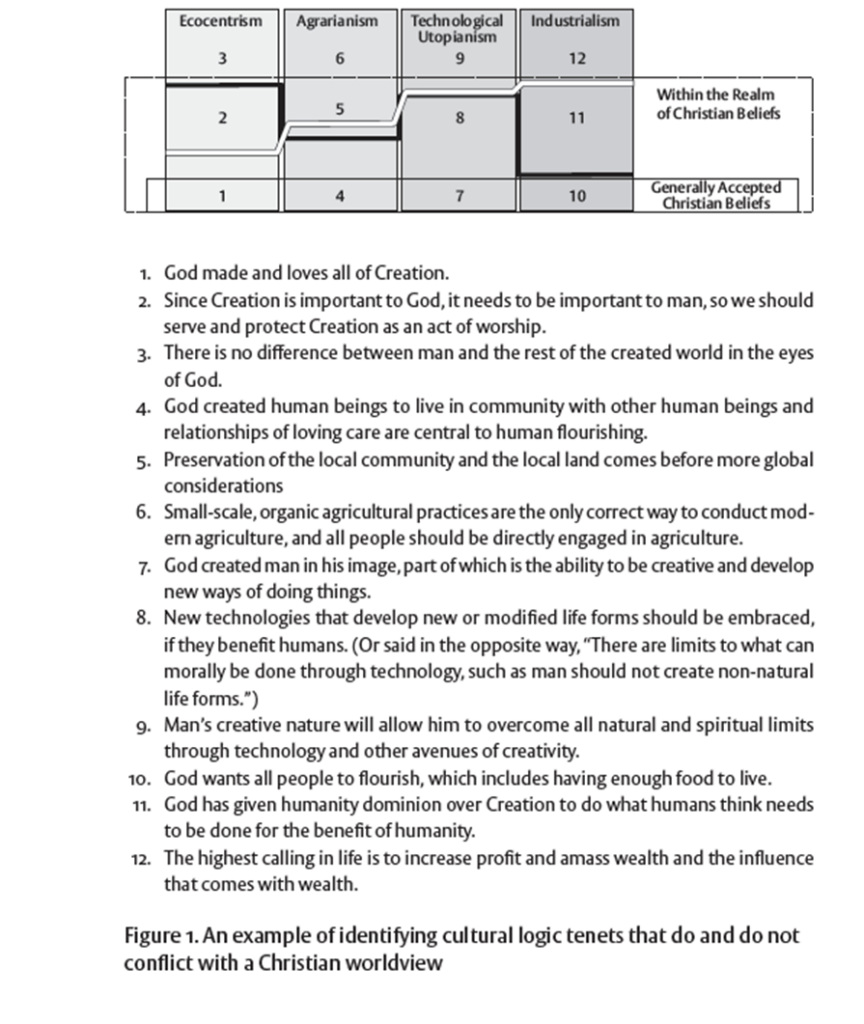
Thankfully, in addition to the Church, there are discipline-specific groups and organizations available to support Christians in agriculture as they navigate through the maze of contradictory and complementary scenarios. An example is the Christian Veterinary Mission (CVM) whose purpose as an organization is to, “. . . walk alongside Christians in the veterinary community whose desire is to bring glory to God through the use of their professional skills . . . to pray with, talk with, encourage, equip, mentor and provide resources and opportunities . . . to follow God’s call in their life . . . serving in their own community or cross-culturally.”[54] The CVM seeks to support veterinarians throughout all phases of their careers and address the inequalities in access to medical care and oversight of food animal health and production and companion animal well-being. While the underlying theme of glorifying Christ is the primary purpose, each of the four cultural logics are not explicitly stated in all of the CVM activities. Less overtly Christian and more conspicuously agriculturally-focused are secular organizations such as the National Future Farmers of America Organization (FFA)[55] and the American Farm Bureau Federation,[56] with mission statements that fall within the realm of Christian beliefs (Figure 1), especially for FFA, and with emphasis on agriculture’s strong role in supporting humanity and the world.
As we have outlined, Christians should endeavor to take a theocentric approach to agricultural questions: God is at the center of everything instead of humanity (anthropocentric) or the created non-human world (ecocentric). For example, the theocentric principle suggests that creation has some sort of intrinsic value and exists for both non-anthropocentric and anthropocentric ends. This may be affirmed by ecocentrism, and, to a lesser extent, agrarianism, but may not be affirmed by technological utopianism and industrialism. All cultural logics except (arguably) ecocentrism embrace some version of human dominion or stewardship over creation, as well as the value of human work. The range of expressions of this idea between industrialism, technological utopianism, and agrarianism reflect, to some extent, the range of interpretations of what is entailed by “dominion” within Christian circles.
While none of the logics would explicitly affirm the importance of agape (“love of God and love of neighbor”), agrarianism and technological utopianism contain within them a prioritization of care. Agrarianism emphasizes the health of communities; not in love as Christians would understand it, but in economic solidarity and stewardship. Technological utopianism is centered on a desire for improvement, to some extent, for the benefit of future generations. But note these logics also assume certain beliefs about the nature of human “wellbeing” and the “good” at which we aim. At a fundamental level, the four logics differ in what they consider the central good around which all actions are ordered. In industrialism, production and profit are the central good; in ecocentrism it is the health of the non-human world; in agrarianism it is the sustenance of the family and community; and in technological utopianism it is the growth of human technological capacity for the improvement of the world through agriculture. Below, we seek to further model this process of evaluating agricultural decision making and secular cultural logics in light of Christian truths by considering the question of biological limits.
The Question of Limits
An important illustration for navigating the conflicting claims of secular logics in agriculture as a Christian comes in the notion of limits (physical, ecological, and human), and the question of how agriculture properly relates to limits imposed by scientific laws and by the natural environment. We understand agriculture as a collective human activity that extends human freedom and capacities for food and fiber production within a set of given boundaries, or limits, within the natural ecosystem.
From the time of the earth’s formation, its size and elemental composition have been essentially set. There are no new phosphorus or nitrogen atoms being made on Earth; the same ones are recycled indefinitely. Unless there is a geologic upheaval, there is no new land (at a large scale). It is estimated that about 40% of the earth’s land surface is used for agriculture.[57] The land that is not currently being used for agriculture has limitations due to extreme temperature, ruggedness of landscapes, infertile soils, or lack or excess of water.[58] Less than 4% of the earth’s water resources are fresh, although nearly all of the freshwater is not readily available for human use, as it is stored in ice sheets and deep groundwater.[59]
The limited land, water, and elements define the practical limits of human activities, such as agriculture. At the field scale, farmers have realized the limits for millennia. In pre-industrial agriculture, farmers used fallow cycles, animal manure, and tree biomass (as in shifting cultivation) in renewing soil fertility. In modern industrial agriculture, crop growth and harvest have been sped up using synthetic fertilizers, and the intimate connection between animals and crops through manure-derived soil fertility has largely been lost. Currently, a large portion of the earth’s arable land is used for high-productivity agriculture and for grazing animals as a source of proteins. While land and water resources are being depleted, excess nutrients are polluting local lands to the global ocean. About 21% to 37% of global greenhouse gas emissions are attributed to food production.[60] A group of scientists has proposed nine planetary boundaries (the limits of the earth to assimilate human-induced change) within which humanity can continue to develop and thrive for generations to come.[61] Since this time, six of the nine boundaries have been transgressed.[62]
In some cases, cultural logics navigate physical limitations by seeking to work within them—in other cases, they may be ignored or rejected outright. Industrialism prioritizes control and has a narrow focus on the maximization of production and profit. Because of this focus, it would perceive no good or wisdom to be gained in accepting limits, as limits are best understood as impediments to the important goals of growth and development. Something similar could be said for technological utopianism, with the added belief that it is, in some ways, intrinsic to human nature to use our tools to transcend our limits. It is human nature to create, to build, to grow, and to transform, not only the world around us, but ourselves as well. We are, to the techno-utopian, the limit-transcending creature. Agrarianism emphasizes the importance of limits and agrarian wisdom consists in living in correspondence with the natural capacity of the land and ecosystem. The limits of the land relate to other limits as well, including our neighbors, whose claims upon us limit our choices (though, not our freedom) through a recognition of responsibility. Indeed, human culture itself is a limit we impose upon ourselves, which contributes to our ability to live well. For the agrarian, humanity is the only creature that imposes limits on itself. So, Wendell Berry claims,
Every cultural and religious tradition that I know about, while fully acknowledging our animal nature, defines us specifically as humans—that is, as animals (if the word still applies) capable of living not only within natural limits but also within cultural limits, self-imposed. As earthly creatures, we live, because we must, within natural limits, which we may describe by such names as “earth” or “ecosystem” or “watershed” or “place.” But as humans, we may elect to respond to this necessary placement by the self-restraints implied in neighborliness, stewardship, thrift, temperance, generosity, care, kindness, friendship, loyalty, and love.[63]
For the ecocentrist, the question of limits is complicated. Ecocentrism calls for a recognition of the value of biological life beyond the human, which would require moral demands of restraint and a fundamentally non-dominative stance toward nature. And yet, this does not necessarily imply anything specific about our relationship with limits, beyond recognizing deep interdependence and solidarity with the rest of creation.
Here, we may observe that Christian theology does not always supply direct answers to modern moral dilemmas or quandaries. Faith often informs ethics by providing a narrative that shapes meaning and values.[64] Christian theological traditions, we might say, inform ethics in three ways: First, theology provides an imperative for protecting the value and dignity of human persons and human flourishing within systems that, at times, threaten to degrade, diminish, and harm both individuals and communities.[65] Second, theology directs ethical deliberation by providing basic presuppositions or substrates that set a starting place and boundaries for moral reflection. Finally, different theological traditions inculcate particular moral dispositions.[66] For example, Christians’ “dependence on others should be a sign of our more radical dependence on God, whereas the broader culture tends to see dependence in almost completely negative terms.”[67] Viewed under the lens of limits, agrarianism seems to agree with the Christian worldview, at least as it commends a certain disposition toward limits that has deep resonance in Scripture. However, the local or community focus of agrarianism should be challenged with the growing needs to respond to the humanity’s transgression over the Earth’s safe operational boundaries,[68] and the biospherical egalitarianism of ecocentrism must be challenged with a need to provide for the sustenance of all people, highlighting the importance of a theocentric perspective that allows us to appreciate the human limits as a resident of the God-created earth.
Conclusions and Future Applications
The Christian disposition towards any discipline should be derived from The Great Commandment: “You shall love the Lord your God with all your heart and with all your soul and with all your mind. This is the first and great commandment. And the second is like it: You shall love your neighbor as yourself. On these two commandments depend all the Law and the Prophets” (Matthew 22:37–40). All discussions of Christian perspectives on agriculture should be understood as determining the practices and framings that best allow us to first, love God and second, humanity. Any agricultural practice or approach which denies the love of God manifested in his love of humans and creation and our Christian love of our neighbors is anathema to the Christian perspective; however, the difficulty often lies in determining whether or not a particular practice falls inside or outside these bounds.
Agriculture touches the lives of all people—therefore, all Christians have some measure of obligation to understand how their faith should inform their choices. While this obligation is important even for Christians whose interaction with agriculture is limited to the food they eat and other agricultural products they use, it is significantly weightier and more complex for those who professionally practice agriculture, whether as producers, researchers, businesspeople, or educators.
Christian agricultural educators, either in the context of formal schooling or agricultural extension, have a responsibility to ensure that their own disposition towards agriculture is well-informed by their faith and cognizant of assumptions they have assimilated from cultural logics and secular worldviews. They must also aid in the moral formation of both those they teach and their fellow colleagues. Christian educators may find themselves addressing the different viewpoints toward agriculture between the professors and students in different disciplines, e.g., environmental sciences versus agronomy, or from different backgrounds, e.g., urban versus rural. During these encounters, it may seem, for example, that the former group favors ecocentrism or technocratic utopianism, while the latter favors agrarianism or industrialism. Regardless, approaching all groups with a Christ-filled mindset can set the stage for meaningful discussion, learning, and growth. While this dimension of education is most obvious and perhaps easily accomplished in faith-based institutions, Christian educators at secular universities should also consider moral formation, promotion of dialogue and empathy, and encouragement of reflection appropriate to and respectful of a pluralistic context part of their duty as faithful witnesses to Christ.
An example of an endeavor from Christ-centered faculty in the agricultural sciences to teach students about food production in a public, secular university setting can be found at the University of Minnesota in an Honors Student Seminar course titled “Food as a Cultural Good,” jointly taught by several of this paper’s authors. This course consisted of 15 weekly sessions for one semester with students from all years of their college education, from any major, and of diverse socioeconomic, gender, faith, and political backgrounds. The course was designed to help the students, instructors, and guest lecturers explore their personal values, ethics, and social, cultural, and religious aspects of food production and consumption. During the semester, we examined some core issues faced by producers, suppliers, and consumers around the world. We posed and answered questions regarding the relationship of agricultural and ecological processes, roles of individual farmers and agribusiness, religious and cultural considerations, and personal choices to help the students construct a personal framework around food. In addition to class discussions following faculty lectures, students presented their research findings on some of the big challenges facing global food production and consumption.
Moral formation of students and colleagues is often just a portion, albeit significant, of the responsibilities of any university faculty member in the agriculture disciplines. Another portion is devoted to research and the support of an agricultural community, including farmers, businesses, and others in need of advancement and support. To that end, research funding often comes from groups with specific demands; this funding is likely critical for the ongoing operation of university research programs. As such, research programs and associated infrastructure are built up within the university for the agriculture and food industries, thereby directly contributing to industrialism. In seeking solutions to agricultural problems, technological utopianism is often a predominant stance. Taken at face value, this may seem untenable to the Christian educator who is striving to embrace all the cultural logics. Fortunately, Christians can rely on both their faith as a moral guide individually and their institution’s support of academic freedom professionally to do meaningful research for the benefit of many using open-access publications and the classroom to share the results.
It is indisputable that the current practices in much of modern agriculture are deeply broken. We indeed see that “the whole creation has been groaning together” (Romans 8:22). The manifestations of this brokenness are manifold: from the environmental degradation and climate change caused by agriculture to the tenth of the world’s population left hungry by current practice,[69] but ultimately all stem from the sin which ruptures our right relationship with God, with each other, and with the created world. Christians engaged in the practice, study, and teaching of agriculture have a position from which to bring the redemptive light of Christ into this brokenness and disorder, by countering the practices and pathways of exploitation, apathy, and greed in which parts of agriculture are mired. Our ability to participate in this redemptive work can be aided by a greater understanding of the cultural logics which direct the current practice of agriculture, and by identifying the ways in which our interaction with these logics can be shaped by our faith to love the land, our neighbor, and the Lord our God.
[1]. This paper is the product of a working group on Christianity and Agriculture, organized in partnership between faculty and students at the University of Minnesota and Anselm House, a Christian study center. This group was composed of faculty, graduate students, and practitioners representing a variety of disciplinary perspectives, including applied plant science, water resources science, soil science, veterinary medicine, horticulture, environmental engineering, and religious ethics. Reading agrarian, theological, and humanistic texts alongside scientific articles from members’ disciplines provided a fruitful context for identifying the cleavages between different perspectives of agriculture in our time.
[2]. Cynthia Nickerson et al., Trends in US Farmland Values and Ownership (US Department of Agriculture, Economic Research Service, 2012), https://www.ers.usda.gov/publications/pub-details/?pubid=44660.
[3]. We do not mean to imply that pre-Industrial Revolution or pre–20th century agriculture were in an Edenic state: to the contrary, we are keenly aware that ethical problems have always been present in agriculture—particularly with regards to exploitive labor practices, including slavery and serfdom. Indeed, Christians engaged in agriculture today must be committed to combating the modern versions of these practices, and a host of other ancient evils with changing faces. However, we do believe that industrialization and corporatization have massively increased the scale of destruction possible to both the environment and human societies. As scientists, we believe that these particular challenges are the ones we are best equipped to speak to.
[4]. All scripture quotations come from the English Standard Version unless otherwise noted.
[5]. Ann Swidler, “Cultural Expression and Action,” in International Encyclopedia of the Social & Behavioral Sciences, ed. Neil J. Smelser and Paul B. Baltes (Pergamon, 2001), 3063–3069, https://doi.org/10.1016/B0-08-043076-7/04071-7.
[6]. Allan Nevins, The Origins of the Land-Grant Colleges and State Universities: A Brief Account of the Morrill Act of 1862 and Its Results (Civil War Centennial Commission, 1962).
[7]. Lauren Valentino, “Cultural Logics: Toward Theory and Measurement,” Poetics 88 (2021): 101574, https://doi.org/10.1016/j.poetic.2021.101574.
[8]. Ann Swidler, “Cultural Expression and Action,” in International Encyclopedia of the Social & Behavioral Sciences, ed. Neil J. Smelser and Paul B. Baltes (Pergamon, 2001), 3063–3069, https://doi.org/10.1016/B0-08-043076-7/04071-7.
[9]. Peter Berger and Thomas Luckmann, The Social Construction of Reality: A Treatise in the Sociology of Knowledge (Anchor Books, 1966).
[10]. Max Weber, “Objectivity in Social Science and Social Policy,” in The Methodology of the Social Science, ed. Edward A. Shils and Henry A. Finch (1904, repr., Free Press, 1949), 49–112.
[11]. Milton Friedman, “A Friedman Doctrine—The Social Responsibility of Business Is to Increase Its Profits,” The New York Times, September 13, 1970.
[12]. Wallaces Farmer, “Iowa Honors Century Farms and Heritage Farms,” Farm Progress, August 20, 2015, https://www.farmprogress.com/farm-business/iowa-honors-century-farms-and-heritage-farms.
[13]. Richard Anderson and Bernard Jansen, Wisconsin Conservation History (US Department of Agriculture, Natural Resources Conservation Service, 2010).
[14].USDA National Agricultural Statistics Service, 2022 Census of Agriculture (February 2024), retrieved April 16, 2024, https://www.nass.usda.gov/Publications/AgCensus/2022/index.php.
[15]. Andrew McLaughlin, “Industrialism and Deep Ecology,” in Explorations in Environmental Political Theory: Thinking about What We Value, ed. Joel J. Kassiola (New York: Taylor & Francis Group, 2002), 104–127.
[16]. Maurice Lagueux, “Learning from the Debate on Externalities,” in Economics and Methodology: Crossing Boundaries (Palgrave Macmillan, 1998), 120–147.
[17]. James Salzman et al., “The Global Status and Trends of Payments for Ecosystem Services,” Nature Sustainability 1, no. 3 (2018): 136–144, https://doi.org/10.1038/s41893-018-0033-0.
[18]. Arne Næss, “The Shallow and the Deep, Long-Range Ecology Movement. A Summary,” Inquiry 16, no. 1-4 (1973): 95–100, https://doi.org/10.1080/00201747308601682.
[19]. Heather Washington, Ben Taylor, Helaine Kopnina, Peter Cryer, and John J. Piccolo, “Statement of Commitment to Ecocentrism,” The Ecological Citizen, 2022, https://www.ecologicalcitizen.net/statement-of-ecocentrism.php.
[20]. E. O. Wilson, Half-Earth: Our Planet’s Fight for Life (Liveright, 2016), https://books.google.com/books?id=gft1CQAAQBAJ.
[21]. Ivette Perfecto, John H. Vandermeer, and Angus Wright, Nature’s Matrix: Linking Agriculture, Conservation and Food Sovereignty (Earthscan, 2009), https://books.google.com/books?id=lcPq48XHgWcC.
[22]. Gary L. Comstock, “An Extensionist Environmental Ethic,” Biodiversity & Conservation 4, no. 8 (1995): 827–837, https://doi.org/10.1007/BF00056190.
[23]. Paul D. Capel et al., “Agriculture—A River Runs Through It—The Connections Between Agriculture and Water Quality,” US Geological Survey Circular 1433 (2018): http://pubs.er.usgs.gov/publication/cir1433; Kendra McLauchlan, “The Nature and Longevity of Agricultural Impacts on Soil Carbon and Nutrients: A Review,” Ecosystems 9, no. 8 (2006): 1364–1382, https://doi.org/10.1007/s10021-005-0135-1.
[24]. William F. Ruddiman, “The Anthropogenic Greenhouse Era Began Thousands of Years Ago,” Climatic Change 61, no. 3 (2003): 261–293, https://doi.org/10.1023/B:CLIM.0000004577.17928.fa.
[25]. Paul J. Crutzen, “Geology of Mankind,” Nature 415, no. 6867 (2002): 23, https://doi.org/10.1038/415023a.
[26]. Arne Næss, “The Shallow and the Deep, Long-Range Ecology Movement. A Summary,” Inquiry 16, no. 1-4 (1973): 95–100, https://doi.org/10.1080/00201747308601682.
[27]. Colin Tudge, “Lies, Misconceptions and Global Agriculture,” The Ecological Citizen 2 (2018): 77–85, https://www.ecologicalcitizen.net/article.php?t=lies-misconceptions-global-agriculture.
[28]. C. Levis et al. “Persistent Effects of Pre-Columbian Plant Domestication on Amazonian Forest Composition,” Science 355, no. 6328 (2017): 925–931. https://doi.org/10.1126/science.aal0157
[29]. Wendell Berry, “Health is Membership,” speech at the conference Spirituality and Healing, Louisville, KY, October 17, 1994, https://scienceandsociety.duke.edu/wp-content/uploads/Berry-Health-is-Membership.pdf.
[30]. Paul B. Thompson, “Agrarian philosophy and ecological ethics,” Science and Engineering Ethics 14 (2008): 527–544.
[31]. Aldo Leopold, A Sand County Almanac: With Essays on Conservation from the Round River (Ballantine Books, 1966), 262.
[32]. Deborah Fink, Agrarian women: Wives and mothers in rural Nebraska, 1880–1940 (UNC Press Books, 1992).
[33]. Nancy A. Naples, “Contradictions in Agrarian Ideology: Restructuring Gender, Race‐Ethnicity, and Class 1,” Rural Sociology 59, no. 1 (1994): 110–135.
[34]. Naples, “Contradictions in Agrarian Ideology,” 110–135; Michael J. Martin, Kellie Enns, and Katherine Hartmann, “Agrarianism in Agricultural Education: A Narrative Study,” Journal of Agricultural Education 63, no. 3 (2022): 135–148.
[35]. Mark. T. Mitchell, “Agrarian Hypocrisy and the Evils of Distributism,” Front Porch Republic, January 2012, https://www.frontporchrepublic.com/2012/01/agrarian-hyposcrisy-and-the-evils-of-distributism/.
[36]. E. Bowness and H. Wittman, “Bringing the city to the country? Responsibility, privilege and urban agrarianism in Metro Vancouver,” The Journal of Peasant Studies 48, no. 6 (2021): 1141–1166.
[37]. Hava Tirosh-Samuelson and J. Benjamin Hurlbut, “Introduction: Technology, Utopianism and Eschatology,” in Perfecting Human Futures, ed. J. Benjamin Hurlbut and Hava Tirosh-Samuelson (Springer VS, 2016), https://doi.org/10.1007/978-3-658-11044-4_1.
[38]. Sascha Dickel and Jan-Felix Schrape, “The logic of digital utopianism,” Nanoethics 11, no. 1 (2017): 47–58.
[39]. Nick Bostrom, “Letter from Utopia,” Studies in Ethics, Law, and Technology 2 (2008): 1.
[40]. Michael Spencer Harris, “The Myth of Techno-Transcendence: The Rhetoric of the Singularity” (PhD diss. University of Kansas, 2014).
[41]. Daisy A. John and Giridhara. R. Babu, “Lessons from the Aftermaths of Green Revolution on Food System and Health [Mini Review],” Frontiers in Sustainable Food Systems 5 (2021): Article 644559, https://doi.org/10.3389/fsufs.2021.644559; P. Pinstrup‐Andersen and Peter B. R. Hazell, “The Impact of the Green Revolution and Prospects for the Future,” Food Reviews International 1, no. 1 (1985): 1–25, https://doi.org/10.1080/87559128509540765.
[42]. John and Babu, “Lessons from the Aftermaths of Green Revolution on Food System and Health”; Pinstrup‐Andersen and Hazell, “The Impact of the Green Revolution and Prospects for the Future,” 1–25.
[43]. Peter Thiel, “Against Edensim,” First Things, June 1, 2015, https://www.firstthings.com/article/2015/06/against-edenism.
[44]. Joel Dinerstein, “Technology and its discontents: On the verge of the posthuman,” American Quarterly 58, no. 3 (2006): 569–595.
[45]. Neil McArthur, “AI Worship as a New Form of Religion,” unpublished manuscript, March 2023, https://philpapers.org/archive/MCAAWA.pdf.
[46]. “2020 PRRI Census of American Religion: County-Level Data on Religious Identity and Diversity,” Public Religion Research Institute, July 8, 2021, https://www.prri.org/research/2020-census-of-american-religion/.
[47]. Andrew J. Hoffman and Louis E. Sandelands, “Getting Right with Nature: Anthropocentrism, Ecocentrism, and Theocentrism,” Organization & Environment 18, no. 2 (2005): 141–162.
[48]. Lynn White, Jr., “The Historical Roots of Our Ecologic Crisis,” Science 155, no. 3767 (Mar. 10, 1967): 1203–1207, https://www.jstor.org/stable/1720120; P. Harrison and R. J. Berry, “Having dominion: Genesis and the mastery of nature,” Environmental Stewardship (2006): 17–31.
[49]. Steven Bouma-Prediger, For the Beauty of the Earth: A Christian Vision for Creation Care (Baker Academic, 2010).
[50]. Cornelius Plantinga, Not the Way It’s Supposed to Be: A Breviary of Sin (Eerdmans, 1995), https://books.google.com/books?id=LDD7vgEACAAJ.
[51]. Matthew Henry, Romans, in Matthew Henry Commentary on the Whole Bible (1706), http://www.biblestudytools.com/commentaries/matthew-henry-complete/romans/.
[52]. N. T. Wright, https://ntwrightpage.com/2016/03/30/the-road-to-new-creation/.
[53]. St. Augustine of Hippo, On Christian Doctrine: De Doctrina Christiana, trans. J.F. Shaw, in A Select Library of the Nicene and Post-Nicene Fathers of the Christian Church, ed. Philip Schaff (Hendrickson, 1995), Book II, Chapter 40, paragraph 60, https://ccel.org/ccel/schaff/npnf102/npnf102.v.v.xl.html.
[54]. “Our Story,” Christian Veterinary Mission, accessed August 21, 2024, https://cvm.org/our-story.
[55]. National Future Farmers of America Organization, “Mission and Motto,” FFA, accessed October 14, 2025, https://www.ffa.org/about/who-we-are/mission-motto/.
[56]. American Farm Bureau Federation, “Who We Are,” American Farm Bureau Federation, October 14, 2025. https://www.fb.org/about/who-we-are.
[57]. Erle C. Ellis et al., “Anthropogenic Transformation of the Biomes, 1700 to 2000,” Global Ecology and Biogeography 19, no. 5 (2010): 589–606, https://doi.org/10.1111/j.1466-8238.2010.00540.x.
[58]. Capel et al., Agriculture—A River Runs Through It—The Connections Between Agriculture and Water Quality.
[59]. US Geological Survey, “How Much Water is There on Earth,” US Geological Survey, November 13, 2019, https://www.usgs.gov/special-topic/water-science-school/science/how-much-water-there-earth?qt-science_center_objects=0#qt-science_center_objects.
[60]. Hannah Ritchie, “How Much of Global Greenhouse Gas Emissions Come from Food?” Our World in Data, June 7, 2024, https://ourworldindata.org/greenhouse-gas-emissions-food.
[61]. Johan Rockström et al., “A Safe Operating Space for Humanity,” Nature 461, no. 7263 (2009): 472–475, https://doi.org/10.1038/461472a.
[62]. Katherine Richardson et al., “Earth Beyond Six of Nine Planetary Boundaries,” Science Advances 9, no. 37 (2023): eadh2458.
[63]. Wendell Berry, “Faustian Economics,” Harper’s Magazine, May 2008, https://harpers.org/archive/2008/05/faustian-economics/.
[64]. Stanley Hauerwas, Truthfulness and Tragedy: Further Investigations in Christian Ethics (University of Notre Dame Press, 1977); Stanley Hauerwas, Vision and Virtue: Essays in Christian Ethical Reflection (University of Notre Dame Press, 1981); Alasdair MacIntyre, After Virtue: A Study in Moral Theory (Notre Dame, IN: University of Notre Dame Press, 1985), Chapter 15, “The Virtues, the Unity of a Human Life and the Concept of a Tradition.”
[65]. Richard A. McCormick, “Theology and Bioethics,” Hastings Center Report 19, no. 2 (1989): 5–10, https://doi.org/10.2307/3563132.
[66]. McCormick, “Theology and Bioethics,” 5–10.
[67]. McCormick, “Theology and Bioethics,” 5–10.
[68]. Johan Rockström et al., “A Safe Operating Space for Humanity,” Nature 461, no. 7263 (2009): 472–475, https://doi.org/10.1038/461472a.
[69]. FAO, IFAD, UNICEF, WFP, and WHO, The State of Food Security and Nutrition in the World 2022: Repurposing Food and Agricultural Policies to Make Healthy Diets More Affordable (FAO, 2022).

























I truly appreciated the presentation, “Cultural Logics in Agriculture: A Critical Christian Perspective”.
At the core, as by-products of God’s original creation which He declared “good”, are we as humans not called to seek to maximize the residual, post fall value potential baked into us and the creation as stewards and beneficiaries of God’s loving creation by thoughtfully engaging with these cultural logics which have their own value potential to serve God’s purposes and reflect His glory?